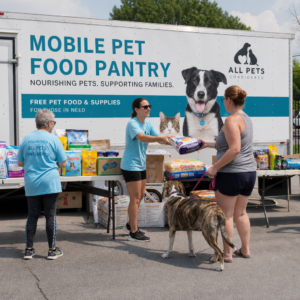
This is an illustrative story inspired by mobile pet food pantries in many communities. It isn't about one specific pantry, but you'll find real ways to get or give help below.
In every neighborhood, there are stories that rarely make the front page, stories carried in the hum of an engine, the rustle of donated bags, and the grateful wag of a tail. The local mobile pet food pantry is one of those quiet miracles, moving from block to block with more than kibble and canned food in its cargo. It brings relief to families facing hard times, keeps beloved animals at home where they belong, and reminds everyone that compassion can travel, meet people where they are, and still feel deeply personal.
Quiet Heroes Feeding Pets and Hope Each Week
Every week, before the sun has fully settled over the streets, volunteers gather with boxes, leashes, clipboards, and kind smiles. They load the mobile pantry with pet food, treats, litter, and supplies, preparing for a journey that is less about miles and more about mercy. Many of these volunteers are not professionals in the traditional sense; they are neighbors, retirees, students, and pet lovers who have decided that a full bowl should never be a luxury.
When the pantry arrives, it often becomes a small island of relief in the middle of an exhausting season. Families who have been stretching every dollar can quietly receive help without shame, and the pets waiting at home continue to be fed, cared for, and loved. For many, this support is what keeps a cat from disappearing into a shelter intake or a dog from being surrendered because food costs became too heavy to carry.
What these weekly visits offer cannot be measured only in pounds of pet food. They restore a sense of control, dignity, and possibility. A bag of food can mean a pet stays in a familiar bed, a child keeps their comforting companion, and a household breathes easier knowing that love does not have to be abandoned when money gets tight. In that way, the volunteers are not simply feeding animals, they are protecting bonds that hold families together.
How a Mobile Pantry Turns Neighbors Into Family
A mobile pet food pantry does something remarkable: it turns a stop on a route into a place of belonging. People arrive as strangers, sometimes carrying worry, embarrassment, or exhaustion, and leave with supplies, and often with a lighter heart. The exchange is practical, but the spirit behind it is deeply human: “You are not alone, and neither is the pet you love.”
Over time, familiar faces begin to appear. Volunteers remember names, pet breeds, favorite flavors, and the little details that make each visit feel personal. Someone may ask after a senior dog’s sore joints, another may share a story about a kitten rescued from a storm drain, and a conversation that began with a donation becomes a genuine relationship. In these moments, the pantry becomes more than a service site; it becomes a meeting place where empathy learns everyone’s name.
This is how community grows, not only through grand gestures, but through repeated acts of care that say, again and again, “We will show up.” The mobile pantry invites neighbors to see one another with softer eyes, to notice struggle without judgment, and to offer help in ways that preserve pride. In the process, people who may never have met under other circumstances become part of the same story, bound together by the shared belief that every pet deserves food, every family deserves support, and every act of kindness can ripple far beyond the curb.
The local mobile pet food pantry is a reminder that hope does not always arrive in dramatic fashion. Sometimes it comes in a van, parked by a sidewalk, with volunteers unloading supplies and greeting each person like a friend. In those ordinary moments, something extraordinary happens: hunger is eased, animals remain with the people who love them, and neighborhoods discover the quiet strength of caring for one another.
Need help feeding a pet, or want to start a pantry?
- If you need pet food: call your local animal shelter or humane society and ask about pet food banks. Many human food banks also carry pet food, and 211 can point you to programs nearby.
- To help: donate unopened pet food to a shelter or food bank, or volunteer at a pet food drive.
- To start one: partner with a local shelter, food bank, or pet store, set up collection bins, and pick a regular time and place so families know when to come.
For more ideas, see 26 Ways to Give Someone a Chance.