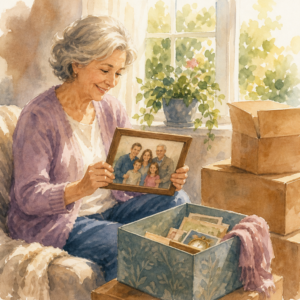
Whether you're moving to a smaller home, a senior community, or in with family, downsizing is about much more than stuff. Every room holds memories: the kids' artwork, the good china, tools from a parent, decades of photos. Sorting through it all can feel exhausting and emotional, even when the move is something you want.
The good news is that with time, a plan, and a little help, downsizing can feel freeing. Here's how to do it gently.
Getting started
1. Give yourself more time than you think
Clearing out a home you've lived in for years usually takes months, not weekends. If you can, start well before the move. Short sessions of an hour or two keep it from becoming overwhelming.
2. Know your new space
Get the floor plan and measurements of your new home. Knowing that you have room for one sofa, one bookcase, and a small dining table makes decisions much easier. Some people sketch their new rooms on paper and decide where their favorite pieces will go first.
3. Start with the easy rooms
Begin with spaces that hold fewer memories, like a linen closet, the garage, or a guest room. Save photos, letters, and keepsakes for last, once you've built some momentum.
Deciding what to keep
4. Sort into simple piles
Use four piles or boxes: Keep, Give to family or friends, Sell or donate, and Toss or recycle. Try to touch each item only once. If you're stuck, a "maybe" box with a date to revisit is fine.
5. Ask helpful questions
- Have I used this in the last year?
- Do I love it, or do I just feel guilty letting it go?
- Will it fit, and is there a place for it, in my new home?
- Could someone else use and enjoy it more?
- If I keep one, do I need all of them? (One special mug instead of twelve.)
6. Keep the memory, not necessarily the thing
Take photos of items you love but can't keep, like a child's art project or a big piece of furniture. Choose one or two meaningful pieces from a collection instead of the whole set. Turn a few favorite T-shirts into a quilt, or make a small shadow box of keepsakes. A memory box for each child or grandchild can hold the most precious things.
7. Gather your photos
Boxes of prints and slides take up a lot of space. Many libraries have free scanners, and photo stores and online services can digitize them. Share copies with family, and keep the best prints in one or two albums. It's a wonderful time to record the stories behind them, too. See Save a Family Story.
Passing things on
8. Talk to family early
Ask children and relatives what they would truly like to have, and let them take it now rather than storing it "for someday." Be prepared that grown children may not want the furniture or china you treasured. It isn't a rejection of you, just a difference in space and taste. Letting go is easier knowing someone who loves it has it.
9. Sell, donate, or give away the rest
- Selling: Estate sale companies, consignment shops, and online marketplaces can help with valuable items. Be realistic: most used furniture sells for much less than it cost.
- Donating: Charities like Goodwill, the Salvation Army, and Habitat for Humanity ReStores accept many household items, and some will pick up furniture. Keep receipts if you plan to deduct donations.
- Giving locally: Shelters, refugee programs, schools, churches, and families setting up a first home may welcome furniture, linens, and kitchenware. Local "buy nothing" groups make giving easy.
Be cautious with strangers who offer to buy everything or ask to come into your home. Have a friend or family member with you when people come to pick things up.
Getting help
You don't have to do it alone. Invite a patient friend or family member to help you sort. They can keep you moving and carry the heavy boxes. For bigger moves, a senior move manager can help plan the move, sort belongings, arrange sales and donations, and set up your new home. The National Association of Senior and Specialty Move Managers lists members by area. Your local Area Agency on Aging may also know of low-cost help (call 1-800-677-1116).
Taking care of your feelings
It's normal to feel sad, nostalgic, or even grief-stricken while downsizing, especially after a loss or a health change. Let yourself feel it. Take breaks, look through old photos with someone you love, and share the stories. Remember that the memories and the people matter more than the things, and they're coming with you.
Settling into your new home
- Unpack your bedroom and kitchen first, so daily life feels normal quickly.
- Put a few favorite things, like photos, a quilt, or artwork, where you'll see them every day.
- Introduce yourself to neighbors and try one community activity in your first few weeks. See How to Make Friends as an Adult.
- Enjoy the freedom of less to clean, fix, and worry about.
More help
- How to Care for an Aging Parent
- Help for Seniors: Free Resources for Older Adults and Their Families
- How to Find Purpose After Retirement
- All Life Guides
Home isn't the square footage. It's the people, the stories, and the few treasured things you carry with you into your next chapter.